AI judgment
Where to Start with AI: Three Decisions to Make Before You Buy Another Tool
The scarce part of an AI project is no longer the AI.
Published by 2N2 Solutions ·4 min read
Your board asked about AI again. Somewhere there is a pilot running, and somewhere else a tool nobody has opened since the month it was bought. The budget line is real and growing. What is harder to point at is what changed.
That experience is close to universal right now, and it is not a sign that anything was done badly.
It is a sign that the constraint moved.
Capability is not what is scarce
Microsoft told investors in July 2026 to expect roughly $175 billion in capital spending for its 2027 fiscal year, most of it AI infrastructure. That is one company's guidance, not final spend. Even discounted, it describes a supply of capability expanding faster than almost anything else in business.
Readiness has not kept the same pace. In NTEN and The Bridgespan Group's State of Nonprofit AI, published September 10, 2026, about 39% of organizations had written guidance for AI use in place, and 57% had no dedicated AI budget.
If capability were the binding constraint, readiness would be moving just as fast. It is not. Something upstream of the tool is doing the limiting.
What is scarce
In finance and operations work, the thing in short supply is rarely technical. It is the decisions nobody has made yet.
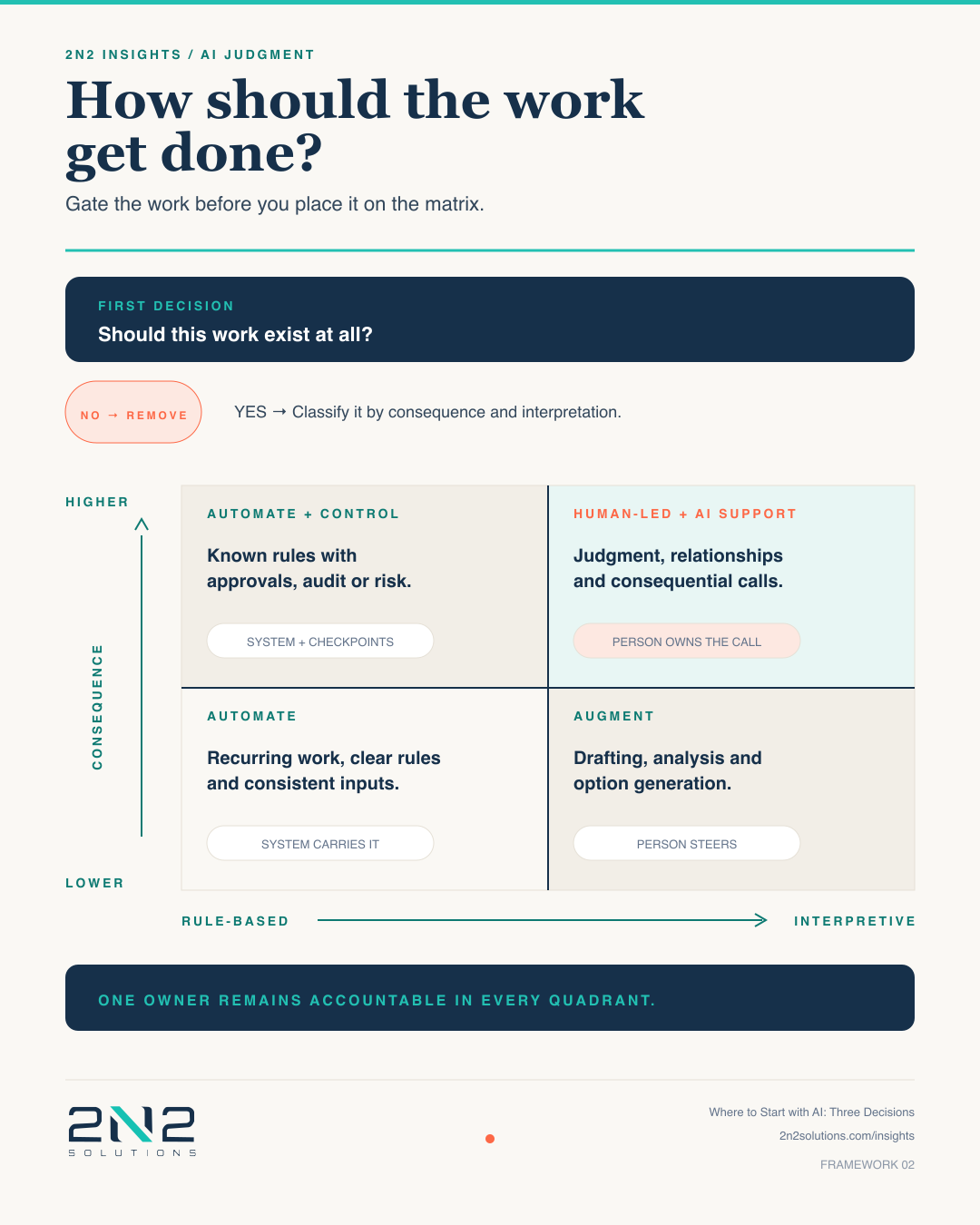
Which work should exist at all. Most processes carry steps designed around a limitation that no longer applies. A summary exists because one team could not read another team's system. Automating that step makes it faster and leaves the reason for it intact. Removing it costs nothing to run afterward.
Which work needs interpretation, and which follows a rule. Inside one process there is work that follows a known rule, work that requires reading what someone meant, and the exception where the facts conflict. Pricing rules belong in a pricing tool. A model is the wrong place to rediscover arithmetic and the right place to understand what a customer was actually asking for.
Who owns the result and can change its shape. A capable engineer can make any step faster. What an engineer usually cannot do is tell another department that a report it has produced for years no longer needs to exist. Without someone accountable for the outcome in the room, every function gets a faster version of its own process, and the person waiting at the end waits exactly as long.
None of these are technology decisions, and none of them gets easier as models improve.
Signals that judgment is the constraint
- The pilot worked and nothing downstream changed. A step got faster and the cycle time a customer experiences stayed flat.
- Nobody can name the decision the tool was meant to improve. If the answer is "visibility," the diagnostic has not happened yet.
- Two systems disagree and no rule says which one wins. Any tool reading both will produce a confident answer, and it will be arbitrary.
- A core definition lives in one person's head. Ask three people what counts as an active customer, or a closed month. Different answers mean anything built on top will be reliably inconsistent.
- Approval steps have no stated purpose. Some are real controls and some are residue. Nobody has separated them, so all of them survive.
An afternoon exercise
Take one path that ends with a person receiving something: a quote, an invoice, a grant report, a board packet. Write down only what has to be true at the end. The answer is correct, the organization is authorized to give it, there is a record, and anything unresolved got asked about.
Then walk the current path backwards against that list and mark each step as required, or as existing because two systems could not talk to each other.
That takes an afternoon and costs nothing. It also tends to change what gets built. The organizations getting real returns are not the ones that bought earlier. They decided what the work should be before deciding what to automate.
Technology follows the strategy. That was true when the technology was a spreadsheet. The falling cost of intelligence has not changed it, only made the cost of skipping the question easier to see on an invoice.
Have one process in mind? See in six questions whether AI could carry it.
Sources
- Microsoft, FY2026 Q4 earnings call, July 29, 2026: fiscal 2027 capital expenditure guidance of roughly $175 billion. Microsoft Investor Relations. Guidance, not final spend.
- NTEN and The Bridgespan Group, State of Nonprofit AI Adoption and Governance, published September 10, 2026, n=917 (404 executives on governance questions). Written AI-use guidance in place now: 38.56%. Designated AI budget not in place: 57.21%. nten.org.